

Parastone
Bird With Letter from Temptation of St Anthony by Hieronymus Bosch, Small
Bird With Letter from Temptation of St Anthony by Hieronymus Bosch, Small
SKU:JB06
In stock
Couldn't load pickup availability
Item Specifics
Item Specifics
- Dimensions (in): 4.5 in. x 4 in. x 2.5 in.
- Weight: 0.4 lb
- Material: Resin with hand-painted color details
- Item type: Bosch statue
- UPC or EAN: 8717202551521
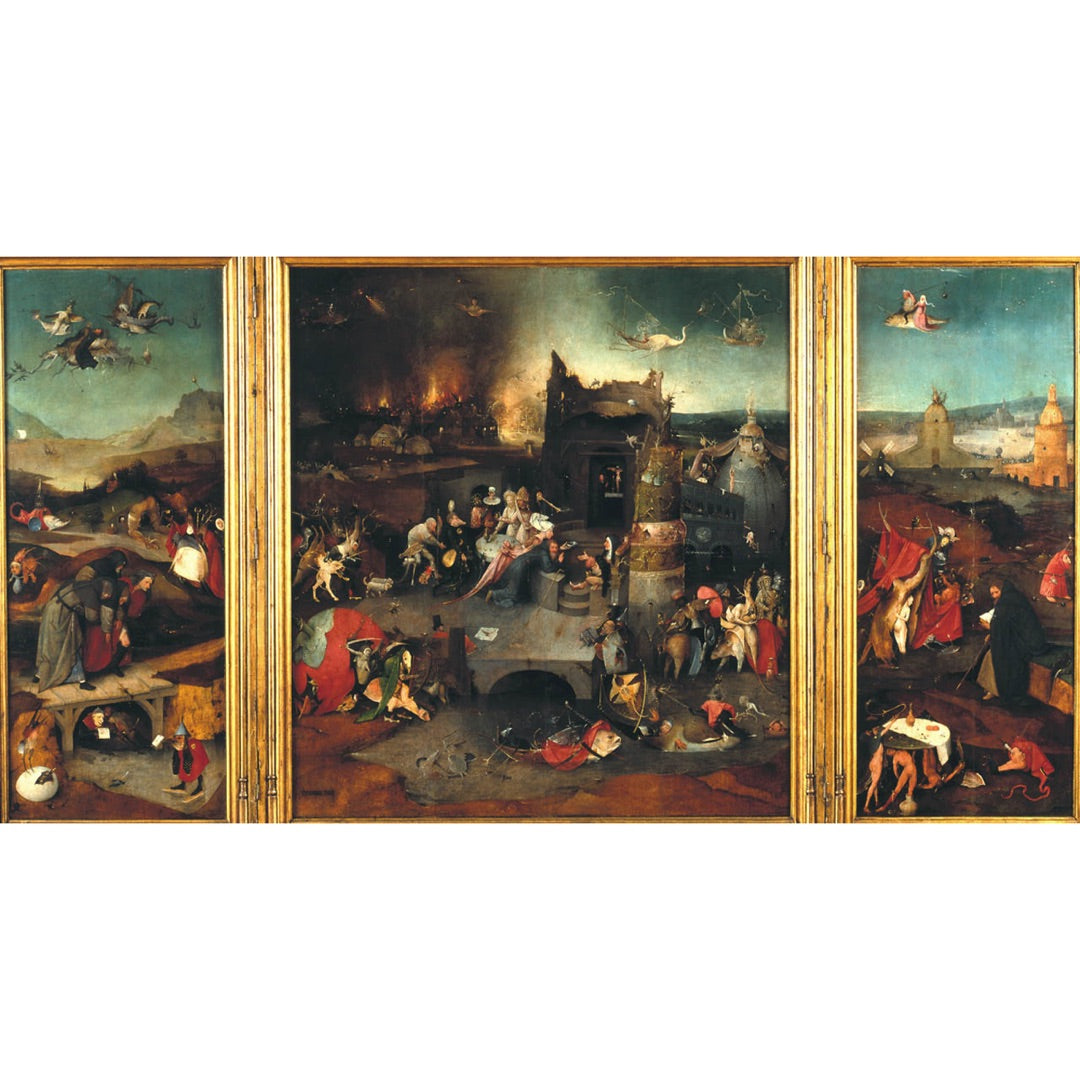
Bird with Letter Statue by Parastone is a three-dimensional representation of the bird figure in the left panel of a religious triptych by Hieronymus Bosch from the Northern Renaissance. The Bird is one of the many freakish figures that appear in The Temptation of Saint Anthony triptych (c. 1500, Museum Nacional de Arte Antiga, Lisbon), which is intended to teach Christian messages to the faithful.
- Medium Size: 4.5" H × 4" W × 2.5" D. 0.4 lbs. PN JB06.
- Material: resin with hand-painted details.
- Part of the Parastone Museum Collection.
Saint Anthony won a lot of praise in Hieronymus Bosch's heyday because he resisted diabolical temptations, in sharp contrast with the ordinary mortals. This birdlike monster wears skates and a tin hat, has a hunchback, and carries a sealed letter in his beak. The inscription on this note could shed light on the beast's intended symbolism. But unfortunately, this text is difficult to read and open to various interpretations. None of which have been proven accurate. The postman-like freak is perhaps delivering a letter to the conspirinworld-famous the hole under the bridge. The funnel on this curious bird's head gives him a preposterous appearance. This headgear is referred to elsewhere as wisdom or absent-mindedness, but that symbolism seems unsuitable here.
Hieronymus Bosch (ca. 1450-1519): From an artistic point of view, the world famous brilliant forerunner of surrealism was, in his day, unique and radically different. Hieronymus (Jeroen for short) Bosch was born (ca. 1450-1516) during the transition from the Middle Ages to the Renaissance in s-Hertogenbosch, in the Duchy of Brabant. Bosch places visionary images in a hostile world full of mysticism, with the conviction that the human being, due to its own stupidity and sinfulness, has become prey to the devil himself. He holds a mirror up to the world with his cerebral irony and magical symbolism, sparing no one. He aims his mocking arrows equally well at the hypocrisy of the clergy as the extravagance of the nobility and the immorality of the people. Hieronymus Bosch's style arises from the tradition of the book illuminations (manuscript illustrations from the Middle Ages). The caricature representation of evil tones down its terrifying implications, but also serves as a defiant warning with a theological basis.
Share